
Design within health contexts is conceived as a way to implement tangible outcomes. Course content will enable the consideration of what it means to live in a complex world, by examining holistic approaches and collective leadership to engage in valued collaboration across disciplines. Creative and collaborative approaches are supported to enable design-led change.
1. Investigate and evaluate a range of design for health concepts, ideas and their practical application.
2. Engage with analytical and critical methods to evaluate and synthesise practice.
3. Contribute to a community of practice, founded on the principles and practices of mātauranga Māori, of manaakitanga (care), motuhaketanga (self-determination) and kōrero pono (speaking truthfully).
4. Engage and apply a range of appropriate technologies or processes for the Design for Health minor.
Design within health contexts is conceived as a way to implement tangible outcomes. Course content will enable the consideration of what it means to live in a complex world, by examining holistic approaches and collective leadership to engage in valued collaboration across disciplines. Creative and collaborative approaches are supported to enable design-led change.
1. Investigate and evaluate a range of design for health concepts, ideas and their practical application.
2. Engage with analytical and critical methods to evaluate and synthesise practice.
3. Contribute to a community of practice, founded on the principles and practices of mātauranga Māori, of manaakitanga (care), motuhaketanga (self-determination) and kōrero pono (speaking truthfully).
4. Engage and apply a range of appropriate technologies or processes for the Design for Health minor.
Survival Mode
Chris Anderson
2024
paper
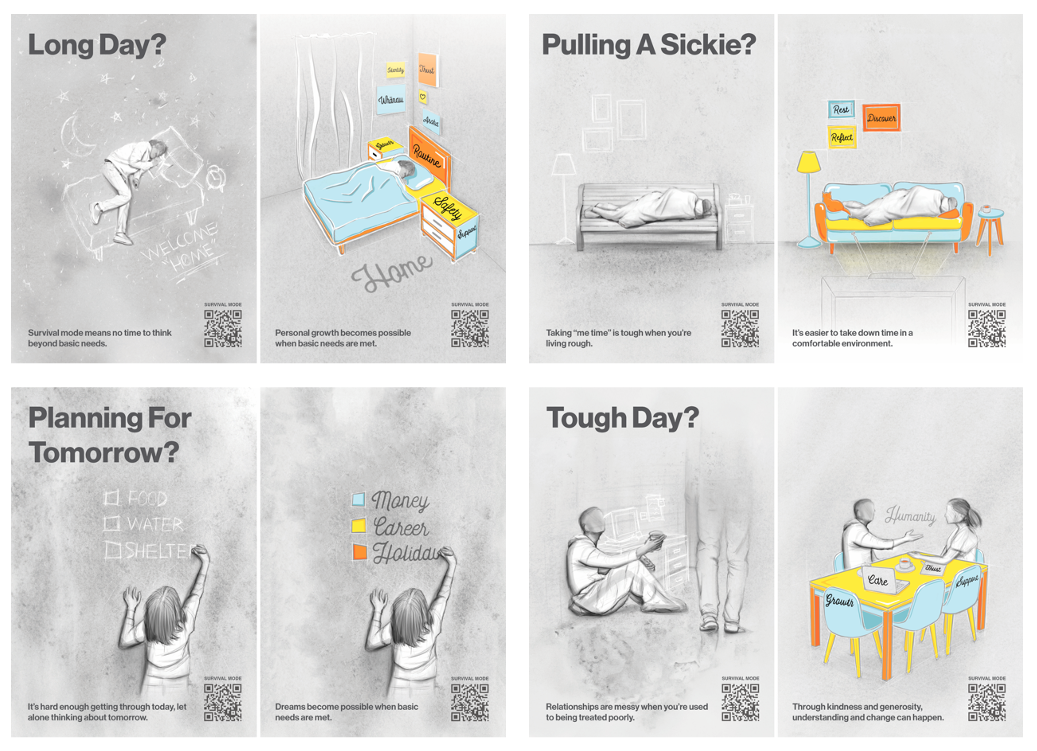
People experiencing homelessness are stereotyped as lazy individuals who shoudl 'get a job'. Yet, surviving on the streets must be tackled before finding employment. As the campaign name suggests, living in "Survival Mode" means no time to think beyond basic needs. The polarising visuals and heavy-hitting taglines highlight the importance of daily routines. They convey how everyone struggles to work when life's challenges throw off their balance, no matter the circumstances. Why should homelessness be an exception?
De-Voice: Addressing Divorce and Homelessness
Nicole Cherize Welthagen
2024
card, wooden frame

This series of three artefacts, crafted to represent the emotional and systemic challenges women face during divorce, sheds light on how patriarchal biases in legal and support systems can lead to homelessness. "Spaces of Grey" and the accompanying pieces aim to raise awareness about these injustices, illustrating the ripple effects on women's lives beyond financial instability — impacting their personal identities, families and communities. The website De-Voice campaign advocates for systemic reform and empowers women through dialogue and advocacy.
Pathways Unseen
Laura-Jane Gooderson
2024
80gsm A2 Cartridge Paper
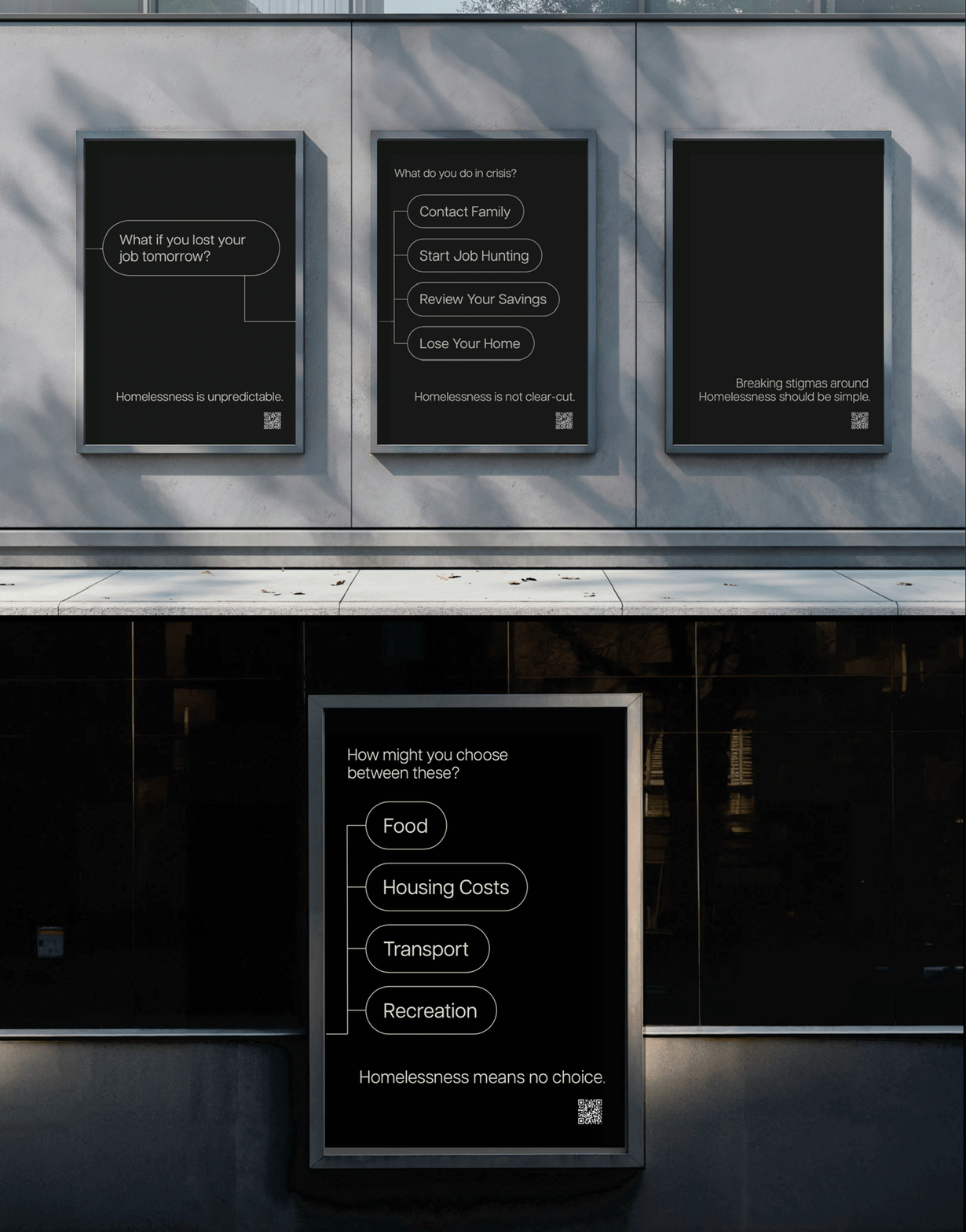
'They made their choices' mentalities are harming those experiencing homelessness, pushing the misconception that they are 'careless' and at fault. Casting prejudice blame, these perceptions disregard the complex structural barriers that compel homelessness. "Pathways Unseen" addresses the audience with these barriers, demonstrating the difficulty and lack of choice each one holds. Switching roles, as a narrative mechanism, supports our understanding of unfamiliar perspectives. Urging the audience to challenge widely accepted perceptions, the campaign acts as an invitation for perspective-shifting conversations.
15
6
150
Click for link to course descriptor


